
Home › Blackjacks News › Rugby 101
Rugby 101Scrum technique: how props, hookers and locks win the scrum
The scrum is rugby's most technical contest: sixteen forwards, one tunnel and a referee's three calls. Here is what Law 19 says, what each front-row and second-row player actually does, how the engagement works, and how to learn scrummaging safely.
Key facts at a glance
- Players: eight per team when both sides have 15 on the field (Law 19.5)
- Calls: "crouch", "bind", "set" (Laws 19.10–19.12)
- Brake foot: the hooker keeps one foot forward until "set" to avoid axial loading (global law trial)
- Feed: from outside the tunnel, without delay, straight, first touching the ground inside the tunnel (Law 19.14)
- Push: only when the scrum begins, straight and parallel to the ground (Laws 19.17, 19.19)
- Free kick change: since 1 July 2024 a team awarded a free kick can no longer choose a scrum instead
- Safety: World Rugby says up to 50% of scrummaging injuries occur during the engagement phase
Ask any forward what separates a good pack from a great one and you will usually hear the same answer: the scrum. It is the one moment in a match where the game stops, the backs step away, and two groups of eight decide who is stronger, lower and better organized. A dominant scrum wins penalties, field position and confidence. A beaten one can lose a match on its own.
For the Vegas Blackjacks, scrummaging goes to the heart of The Blackjacks Way. Its first value is Physical: "We dominate the contact area. Every tackle, every ruck, every scrum is a statement of intent." This guide explains scrum technique for props, hookers and locks: what the law says, what each position does, the engagement sequence, the feed and the strike, the common penalties, and how players progress safely from kneeling drills to a full eight-man scrum.
It is the third part of our forward-play series, after rugby rucking explained and the rolling maul. If you are completely new to the positions, the Vegas Kings' guide to rugby positions explained is a good place to start.
What is a scrum in rugby, and when is one awarded?
World Rugby's Law 19 sets out the purpose plainly: a scrum exists "to restart play with a contest for possession after a minor infringement or stoppage." The most common causes are a knock-on or forward pass, a ball that becomes unplayable at a ruck or maul, and a team choosing a scrum instead of a penalty kick.
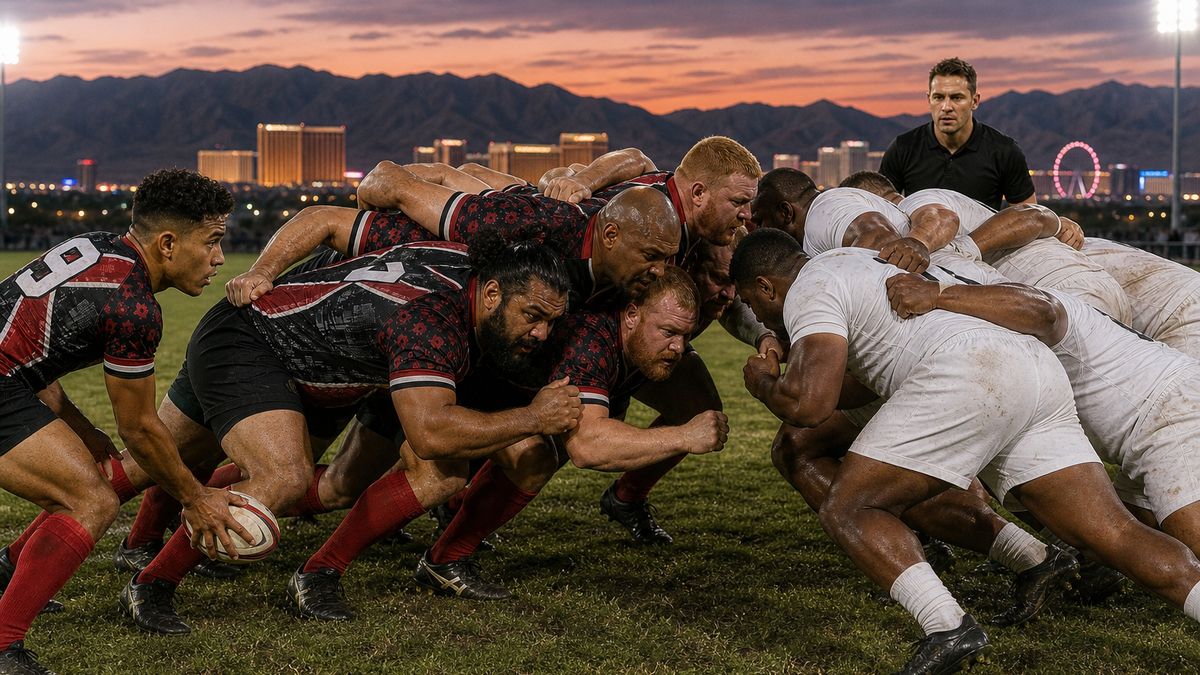
The referee marks the spot, and the scrum forms in the scrum zone at that mark. Teams must be ready to form the scrum within 30 seconds of the mark (Law 19.4). When both teams have 15 players, eight from each side bind together (Law 19.5), in a 3-4-1 shape: three in the front row, the two locks plus two flankers in the middle, and the number 8 at the back.
One recent change matters for anyone used to older rugby. On 9 May 2024, the World Rugby Council agreed a set of law changes that came into effect on 1 July 2024. One of them removed the option to take a scrum when a team is awarded a free kick. A scrum is still an option for a penalty. World Rugby's stated aim was "speeding up restarts after technical offences," and AFP reported at the time (10 May 2024) that the move was part of a wider push to make the game faster.
What do props, hookers and locks actually do?
Every forward has a job at scrum time, and those jobs map closely onto body types. That is why front-row players are often shorter and very wide, and why locks are usually the tallest players on the field.
| Position | Number | Main scrum job | Typical build |
|---|---|---|---|
| Loosehead prop | 1 | Left of the hooker; head outside the opposing tighthead; keeps the scrum up and can attack the tighthead's bind | Short, very wide, strong neck and back |
| Hooker | 2 | Center of the front row; binds both props, uses the brake foot, then strikes for the ball with one foot | Stocky and compact, quick feet |
| Tighthead prop | 3 | Right of the hooker; head between the opposing hooker and loosehead; the anchor of the scrum | The heaviest and most stable front-rower |
| Locks | 4 and 5 | Bind together and push through the props; supply most of the forward drive | The tallest players, long levers, big legs |
| Flankers | 6 and 7 | Bind on the sides of the locks; add push and break away quickly when the ball is out | Big, athletic, quick |
| Number 8 | 8 | Pushes on the two locks; controls the ball at the base and can pick up to attack | Big, powerful ball carrier |
| Scrum-half | 9 | Feeds the ball and plays it away; not part of the pack | Smallest, most agile player |
Law 19.7 spells out how the pack holds together. Props bind to the hooker. The hooker binds with both arms, over or under the props' arms. Locks bind with the props and with each other, and all other players bind on a lock's body with at least one arm. Every one of those binding requirements carries a penalty if it is broken.
People watch the front row, but scrums are won by eight. A tighthead can only anchor if his lock is pushing through him, and the hooker can only strike if the props hold him steady. Get every player's job right and the scrum stops being a lottery.
How does the engagement work? "Crouch, bind, set" explained
The modern engagement sequence is the result of years of research into scrum safety. A University of Bath research program (case study published 9 June 2023), funded with World Rugby, found that the "crouch, bind, set" technique was the one that "most clearly reduced peak forces during scrum engagement." Live scrummaging tests across five levels recorded a 14% to 25% reduction, and World Rugby adopted scrum laws based on the research globally in 2014. A central idea is the pre-bind: props bind on their opponents before the packs engage, instead of crashing in from a distance.
1. Crouch
On the call of "crouch" (Law 19.10), the front rows crouch with heads and shoulders no lower than their hips. Each player's head goes to the left of the opponent's head, and no player's head may touch an opponent's neck or shoulders. The hookers must have a brake foot forward. World Rugby's Clarification 1-2024 defines this as the hooker having "one foot positioned forward in the middle of the tunnel to help stability and to avoid axial loading." The brake foot is a global law trial that World Rugby will review.
2. Bind
On "bind" (Law 19.11), the props bind on their opposite number. The loosehead binds with the left arm inside the right arm of the opposing tighthead; the tighthead binds with the right arm outside the left upper arm of the opposing loosehead. Props grip the back or side of the opponent's jersey. Crucially, all binding is maintained "in the position they started in, for the duration of the scrum." The hooker may adjust the brake foot, but it must still be acting as a brake.
Why does the brake foot matter? In 2019 World Rugby moved to stop "axial loading," where the weight of a whole pack is concentrated through the head and neck of the opposing hooker. RugbyPass reported on 8 July 2019 that the immediately effective amendment would outlaw front rows placing their heads onto opposition players' shoulders between "bind" and "set." The brake foot is part of how the current law keeps that gap safe.
3. Set
Only on "set" (Law 19.12) does the hooker remove the brake foot and the packs come together. All players must be in position, each front-rower must have both feet on the ground, and the hooker's feet must be in line with or behind the foremost foot of their props. From here, nobody pushes until the ball is in.

How does the feed and the hooker's strike work?
Once the scrum is set, the scrum-half of the team awarded the scrum feeds the ball. The feed is a common source of argument, so Law 19.14 is worth knowing in full. The scrum-half throws in from their chosen side, from outside the tunnel, and the throw must be:
- without delay,
- with a single forward movement,
- at a quick speed,
- straight, although the scrum-half may have a shoulder on the middle line, so the ball can enter "a shoulder-width closer" to their own side, and
- so that it first touches the ground inside the tunnel.
Each of those is a free kick if broken. Because the scrum-half feeds from outside the scrum, never from between the packs, a prop or any other forward never puts the ball in.
Now the hooker earns the name. Front-rowers may strike for the ball only once it touches the ground in the tunnel (Law 19.20), and they may use only one foot at a time (Law 19.21). The hooker of the throwing team "must strike for the ball" (Law 19.22). A good strike sweeps the ball back between the loosehead's feet toward the locks and the number 8. Meanwhile the packs may push: "Only when the scrum begins may the teams push" (Law 19.17), and the push must be straight and parallel to the ground (Law 19.19).
When the ball reaches the back, the team in possession has three to five seconds to use it before the referee calls "use it" (Law 19.26). The scrum ends when the scrum-half plays the ball, when the number 8 picks up the ball from the feet of a second-row player, or when the ball leaves the scrum other than through the tunnel (Law 19.36).
The quietest skill in the scrum is the hooker's strike, and it is the one most teams practice least. A clean, quick strike takes pressure off the whole pack. Thirty seconds of strike practice at the end of every forwards session pays for itself on match day.
What are the most common scrum penalties?
Most scrum penalties and free kicks come from a handful of offenses. Here is a plain-language summary of the main ones in Law 19.
| Offense | Law | Sanction |
|---|---|---|
| Not ready within 30 seconds of the mark | 19.4 | Free kick |
| Head or shoulders below hips at crouch; head touching an opponent's neck or shoulders | 19.10 | Free kick |
| No brake foot, or brake foot not acting as a brake | 19.10–19.11 | Free kick |
| Changing or releasing a bind during the scrum | 19.11 | Penalty |
| Early engagement or early push before the ball is in | 19.12, 19.17 | Free kick |
| Crooked, slow or delayed feed | 19.14 | Free kick |
| Not pushing straight and parallel to the ground | 19.19 | Penalty |
| Charging, pulling, lifting or forcing an opponent up | 19.37 | Penalty |
| Intentionally collapsing, falling or kneeling | 19.37 | Penalty |
| Scrum-half or other players offside | 19.27–19.31 | Penalty |
Not every failed scrum is a penalty. Under Law 19.34 the referee resets the scrum if it collapses or breaks up without foul play, if the ball comes straight out of either end of the tunnel, if it is wheeled through more than 90 degrees, or if neither side wins possession. The team that originally threw in gets the reset.
Offside matters too. Players not in the scrum must stay at least five meters behind the hindmost foot of their scrum (Law 19.31), and the scrum-half of the team without the ball has specific places they may stand. For more on how defenders read and pressure set-piece ball once it is out, the Vegas Knights' guide to breakdown defense is worth a read.
Scrum technique by position: practical coaching points
Props: body height and a strong bind
A prop's first job is to stay square and stable. World Rugby's Scrum Ready coaching stages describe the base position: "Head in neutral position," "Shoulder blades back," "Chest ahead of the knees" and "Hips tilted." Coaches often add that props should keep their feet wide enough for a stable base and their backs flat. The coaching warning is simple: "If the head is down, the body will follow." Driving downward is both illegal and dangerous.
The bind matters as much as the body. Law 19.11 fixes where each prop binds, and that bind must stay in place. A prop who drops a bind, pulls an opponent down or turns in toward the hooker will be penalized, and a good referee is watching exactly that.
Hooker: stability, brake foot and strike
The hooker binds both props tightly so the front row moves as one unit, places the brake foot during crouch and bind, removes it only on "set," and then has a split second to strike. Hookers also need to be comfortable with their head and neck between two opponents, which is why they progress through Scrum Ready stages like every other front-rower before playing live.
Locks: the engine room
Locks bind together and with the props, typically with each head in the gap between the hooker and a prop, and their shoulders driving through the backs of the props' upper legs. They supply the bulk of the forward drive, so leg strength and a flat back are essential. Because they are tall, the challenge for locks is getting low enough while keeping the spine in line. The Vegas Lions cover the foundations of building that leg drive in strength training for rugby.
Back row: add weight, then go
Flankers and the number 8 add push and keep the scrum square, then detach quickly once the ball is out. The number 8 also controls the ball at the base. Once the ball is out and the backs attack, the forwards' next jobs are the ruck and the carry, which we cover in our rucking guide.
Is scrummaging safe? How to learn it properly
The scrum carries real risk when it goes wrong, which is why the law and coaching guidance put so much weight on technique and training. World Rugby's Scrum Ready material states that "Players should NOT play in the scrum until they are Scrum Ready." It also notes that several studies have found that "up to 50% of scrummaging injuries occur during the engagement phase," that a mismatch between front rows features in about 25% of scrum injuries, and that lack of front-row experience plays a part in around 40%.
That is why World Rugby's Rugby Ready guidance on the scrum tells referees to check before a match "that all front row players are suitably trained," to blow the whistle early if a scrum becomes unstable, and, "If you have any safety doubts, go to uncontested scrums." In an uncontested scrum the packs form and bind but do not compete or push.
Youth rugby goes further. World Rugby's under-19 law variations, which unions may adopt, require front-row and lock positions to be "suitably trained," with uncontested scrums ordered otherwise. They also make it a free kick to push a scrum more than 1.5 meters toward the opponents' goal line, reset scrums wheeled through more than 45 degrees, and make intentionally wheeling a scrum a penalty.
The safe way to learn follows the Scrum Ready progression: body position on the knees, then standing, then one-on-one with an opponent ("ear to ear" at crouch), then three-on-three ("Do not push until the ball is in"), building up only when the player is competent at each stage. The most important rule is to learn under a qualified coach. In the United States, USA Rugby requires coaches of tackle rugby to hold World Rugby Level 1 certification (required since 1 September 2023), complete Rugby Ready and concussion courses, keep SafeSport training current and pass a background check. Never practice live scrummaging without one. If you take a knock to the head or neck, stop and get checked by a qualified person. This article is not medical advice.
Simple scrum progressions for club training
These are common progressions based on the Scrum Ready stages. Run them with a qualified coach present and only move on when every player is competent.
| Stage | What it trains | Contact level |
|---|---|---|
| Body position on knees | Neutral head, shoulder blades back, flat back, hips tilted | None |
| Standing body position | Same shape on the feet, wide stable base | None |
| Binding walk-through | Front-row and lock binds, whole-arm grip on the jersey | None |
| Crouch, bind, set walk-through | The referee's calls, brake foot timing, holding still on "set" | Low |
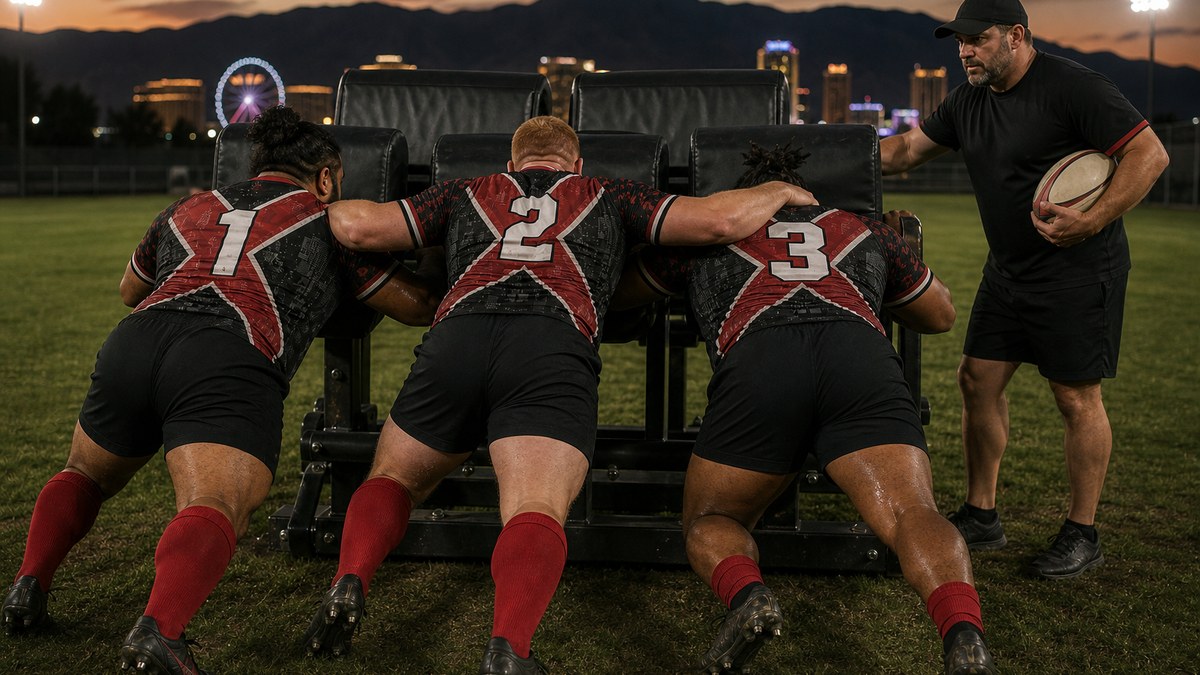
| Front row on a scrum machine | Body height and pushing straight against a padded machine | Moderate |
| 1v1 and 3v3 with a coach | Ear-to-ear crouch, legal bind, no push until the ball is in | Moderate, coached only |
| Hooker strike practice | One-foot strike after the ball touches the ground in the tunnel | None |
| Full 8v8 scrum | The whole sequence against opposition | High, coached only |
Many coaches film scrum sessions on a phone to check body height frame by frame. Our partner Vibe Coding covers how people are building simple tools like video taggers with AI.
Do scrums happen in sevens and tens?
Yes, but the scrum looks different. Sevens uses a three-player scrum, so it is mostly a quick restart. In tens, the format of the APR Games 2027, packs are bigger than in sevens and the scrum is a real contest again, with more space for the backs once the ball is out. Full rules for the APR Games will be confirmed with player registration. Rugby league also has scrums, but they are not contested in the same way; the Kings explain the codes in rugby union vs rugby league, and Downtown Rugby's rugby rules for beginners covers the basics for new players.
The Blackjacks and the forward pack
The Blackjacks have played in Las Vegas since 1976, when a newspaper ad recruited the first players, and the club calls itself the city's oldest sports club. Its honors list counts three national titles, and in 2010 it won the USA Rugby Division I national championship, beating Belmont Shore 36–22. You can read that story in rugby in Las Vegas: a history from 1976 to the APR Games and see real photos in the Blackjacks trophy cabinet.
Championship rugby is built on set pieces that hold under pressure. That is what "Physical" and "Teamwork" mean in practice: eight forwards bound together, low, square and legal, trusting each other through every call.
Thinking of trying the front row? Downtown Rugby's guide to how to start playing rugby as an adult is a good first step, and plenty of big athletes find the pack feels like home.
Pack down in Las Vegas
The APR Games 2027: Memorial Day weekend, May 29–31, Las Vegas. 10-a-side rugby, two 20-minute halves, evening kickoffs across three fields. Men's Elite ($10,000 prize pool), Women's Social ($5,000) and Youth divisions. Player entry $299 includes a jersey, kit bag, at least three pool games and opening-night access.
Join the APR Games waitlistHow to start scrummaging with the Blackjacks
- Join The Breakdown. American Pro Rugby's free weekly newsletter has rugby news, one skill broken down each week and Blackjacks tryout information first. Subscribe here.
- Learn under a coach. APR's coaching clinic runs May 28–31, 2027, alongside the Games.
- Get on the waitlist. Player registration for the APR Games opens through americanprorugby.com.
- Follow the law changes. Keep up with refereeing guidance and results on APR's global rugby news.
Coming to Las Vegas for the Games? Luna Appleton covers where to stay, eat and celebrate in the city. Find team gear in the APR merch store, and meet every franchise on the APR teams page, including the Vegas Knights, Vegas Kings, Vegas Lions and Downtown Rugby.
Nobody becomes a front-rower in a week. The best props and hookers spend months on body position before they ever pack down live, and they never stop working on it. Be patient, train with a qualified coach, and the scrum will become the part of the game you look forward to most.
Frequently asked questions
How many players are in a rugby scrum?
Eight from each team when both sides have 15 players: three front-rowers, two locks, two flankers and a number 8 (Law 19.5). The scrum-half feeds the ball but is not part of the pack.
What does crouch, bind, set mean?
They are the referee's three engagement calls. On crouch the front rows get into position, on bind the props bind on their opponents, and on set the packs come together. Nobody may push until the ball is fed.
What is a brake foot in a scrum?
It is the hooker keeping one foot forward in the middle of the tunnel during crouch and bind, for stability and to avoid axial loading. The hooker removes it only on the set call. It is currently a World Rugby global law trial.
What is the difference between a loosehead and a tighthead prop?
The loosehead (number 1) packs on the left of the hooker with their head outside the opposing tighthead. The tighthead (number 3) packs on the right, with their head between the opposing hooker and loosehead, and is usually the anchor of the scrum.
Who feeds the ball into the scrum?
The scrum-half of the team awarded the scrum. They throw it in from outside the tunnel, straight, without delay and so that it first touches the ground inside the tunnel (Law 19.14).
When can the hooker strike for the ball?
Only once the ball touches the ground in the tunnel, and only with one foot at a time (Laws 19.20 and 19.21). The hooker of the team throwing in must strike for it.
Can a team choose a scrum from a free kick?
No. Since 1 July 2024, World Rugby law no longer allows a team awarded a free kick to choose a scrum instead. A scrum is still an option when a penalty is awarded.
What is an uncontested scrum?
A scrum where the packs form and bind but do not compete or push. Referees order them when suitably trained front-row players are not available or when there are safety concerns.
Can beginners play in the front row?
Only after they are trained. World Rugby says players should not play in the scrum until they are Scrum Ready, and the front row should be learned step by step under a qualified coach.
Are there scrums at the APR Games?
The APR Games 2027 are 10-a-side union rugby, so scrums are part of the game. Full rules will be confirmed with player registration.
Keep reading
Sources
- World Rugby Passport: Laws of the Game, Law 19 Scrum (accessed 9 November 2026)
- World Rugby Passport: Under-19 law variations, Law 19 Scrum (accessed 9 November 2026)
- World Rugby: Law changes, 1 July 2024 (agreed 9 May 2024)
- World Rugby: Law Clarification 1-2024, brake foot (February 2024)
- World Rugby Passport: Rugby Ready, The scrum (accessed 9 November 2026)
- World Rugby Passport: Rugby Ready, Scrum Ready (accessed 9 November 2026)
- University of Bath: Reducing injuries in rugby union through global changes to make the scrum safer, 9 June 2023
- RugbyPass: World Rugby ban potentially catastrophic practice of axial loading at scrums, 8 July 2019
- AFP via Rugby Australia: World Rugby ditches scrum option from free kick, 10 May 2024
- USA Rugby: Coaching education and compliance requirements (accessed November 2026)
- American Pro Rugby: APR Games 2027
This article explains the laws and common coaching points for the scrum using the World Rugby, USA Rugby and other sources listed above, current as of November 2026. Laws, guidelines and law trials change and competitions and unions adopt them at different times, so check with your referee or union. Rugby is a contact sport: learn scrummaging and all contact skills under a qualified coach, and never play in the front row until you are trained for it. This article is not medical advice.