
Home › Blackjacks News › Rugby 101
Rugby 101Rugby sevens explained: rules, format and why speed rules
Seven players, fourteen minutes and the same size of field as the full game. Here is how rugby sevens works, how its laws differ from fifteens, how tournaments and the HSBC SVNS series run, and what it takes to play it.
Key facts at a glance
- Players: seven on the field, up to five replacements (sevens Law 3)
- Match length: 14 minutes, two halves of up to 7 minutes; finals up to 20 minutes (sevens Law 5)
- Extra time: five-minute periods, first score wins (sevens Laws 5 and 8)
- Conversions: drop kick only, within 30 seconds of the try (sevens Law 8)
- Restart: the scoring team kicks off with a drop kick (sevens Law 12)
- Scrum: three players per team (sevens Law 19)
- Olympic sport: since Rio 2016; next at LA28 with 12 men's and 12 women's teams
- 2026-27 HSBC SVNS: opens this weekend in Dubai, 28-29 November 2026
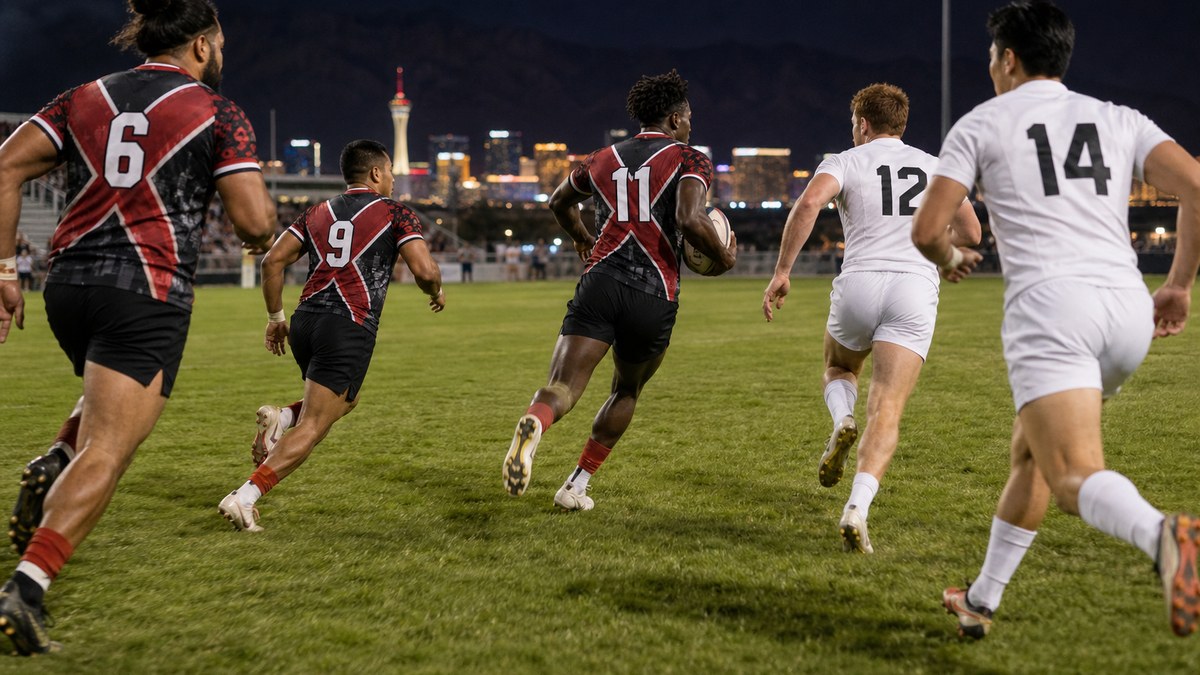
Sevens is rugby with the volume turned up. There are fewer bodies on the same-size field, so gaps that never exist in fifteens open up every few seconds. One missed tackle can become a 70-meter try. One turnover at the breakdown can swing a match in ten seconds. And because a game lasts only 14 minutes, there is no time to settle in.
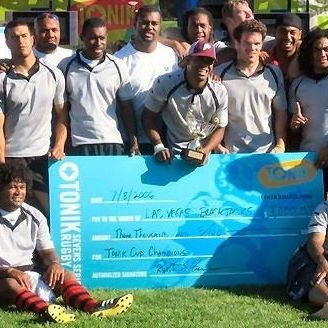
It is also a format the Vegas Blackjacks know well. The club's honors list includes the 2006 Tonik Sevens title, and Las Vegas spent a decade as one of the best-known stops on the world sevens circuit. This guide covers rugby sevens explained from the ground up: how the game began, how its laws differ from fifteens, how tournaments and the HSBC SVNS series work, which positions you play, and how to train for it safely.
If you are brand new to rugby, start with Downtown Rugby's guide to rugby rules for beginners. If you want the 10-a-side format of the APR Games, the Vegas Kings have rugby tens explained.
What is rugby sevens, and where did it come from?
Sevens is a variation of rugby union, not a separate code. It uses the same Laws of the Game as fifteens, with a short list of official changes that World Rugby publishes as the sevens law variations. The ball, the pitch, the in-goal areas and the value of a try are all the same.
The format began in the Scottish Borders. According to the history of the game, sevens was first played in 1883 in Melrose, Scotland, conceived by Ned Haig and David Sanderson, two local butchers, as a fund-raising event for Melrose RFC. A one-day tournament of short matches suited a small club with limited players, and the idea spread.
More than a century later sevens reached the biggest stage in sport. Rugby sevens made its Olympic debut at Rio 2016, where Fiji won the men's gold and Australia the women's. At Paris 2024, France won the men's gold on home soil, New Zealand retained the women's title, and the United States women won bronze, which Team USA reported on 30 July 2024 as the country's first-ever Olympic medal in rugby sevens.
How are the sevens laws different from fifteens?
Most of what you know from fifteens still applies: tries are worth five points, conversions two, penalty goals and dropped goals three. The tackle, ruck, maul, offside and knock-on laws are the same. The differences are about time, numbers and restarts. Here are the main ones, taken from World Rugby's official sevens variations.
| Area | Sevens | Fifteens |
|---|---|---|
| Players on the field | 7 | 15 |
| Replacements | Up to 5 (sevens Law 3.4) | Up to 8 in most senior matches |
| Match length | 14 minutes: two halves of up to 7 minutes (Law 5.1) | 80 minutes: two 40-minute halves |
| Finals | Up to 20 minutes: two halves of up to 10 minutes | Same as any match |
| Half-time | Up to 2 minutes (Law 5.2) | Up to 15 minutes |
| Extra time | Five-minute periods after a one-minute break; first team to score wins | Set by competition rules |
| Conversions | Drop kick only, within 30 seconds of the try (Laws 8.7, 8.8) | Place kick or drop kick |
| Penalty kick at goal | Drop kick only (Law 8.24) | Place kick or drop kick |
| Kick-off after a score | Scoring team kicks off within 30 seconds (Law 12.4) | Non-scoring team kicks off |
| Scrum | 3 players per team, ready within 15 seconds (Laws 19.4, 19.5) | 8 players per team, ready within 30 seconds |
| Yellow card | 2 minutes in the sin bin | 10 minutes in the sin bin |
The law text is precise. World Rugby's sevens Law 5 says "A match lasts 14 minutes (split into two halves, each of not more than seven minutes) plus time lost," and that "A competition final match may last no longer than 20 minutes." When extra time is needed, "the team that scores points first is immediately declared the winner, without any further play" (sevens Law 8.30).
The two-minute sin bin is a big deal in a 14-minute game. Rugby World (1 July 2022) puts it simply: "A yellow card results in a two-minute sin bin, rather than ten." Playing a man down for two minutes in sevens is roughly the same share of the match as twenty minutes in fifteens. That is why discipline matters so much in the short game; the Vegas Knights break down how to stop giving away penalties.
The scoring team kicking off is the law that changes sevens most. Score, and you have to win the ball back straight away. That is why the best sevens sides treat the restart as an attacking set piece, not a breather.
Why does speed rule in rugby sevens?
Do the math. A fifteens team defends a pitch up to 70 meters wide with 15 players. A sevens team defends the same width with seven. That is twice the space per defender, so every attacker has more room to beat a man, and every defender has more grass to cover on his own.
That is why sevens squads are built around pace. The game rewards the first three steps, acceleration into space and the ability to chase down a breakaway. If you want to build that kind of speed, the Vegas Lions' guide to rugby speed training and the first 10 meters is a good place to start.
Speed is only half of it. Sevens is also brutally demanding on fitness. A match is short, but players make sprint after sprint with little rest, and tournament teams play several matches in a day or a weekend. Repeat effort matters as much as top speed, which is the theme of the Knights' guide to rugby fitness for defenders.
Possession is precious
With fewer players, every possession is worth more. Teams keep the ball for long phases, recycle it fast and wait for a defender to make a mistake. A turnover is often a try at the other end. That puts a premium on clean ball at the breakdown: the tackled player places the ball, one or two teammates secure it, and the rest stay on their feet and in the line. The principles are the same as our rucking guide, but with fewer bodies committed.
Defense is one-on-one
Defenders in sevens often face an attacker in open space with no inside cover. Good sevens defenders keep their feet, stay square, force the runner toward the touchline and make a low, legal tackle. Missed tackles are costly, which is why the Knights' guide to how to tackle in rugby safely is required reading for anyone stepping into the format.
What positions are there in sevens?
A sevens team has three forwards and four backs. The names come from fifteens, but in sevens everyone needs to handle, tackle in space and run.
| Role | Players | Main jobs in sevens |
|---|---|---|
| Props and hooker | 3 forwards | Form the three-player scrum, win restarts and lineouts, secure the ball at the breakdown, tackle in the middle |
| Scrum-half | 1 | Feeds the scrum, plays the ball away from the breakdown, organizes the defense |
| Fly-half | 1 | Main decision-maker, often the restart and conversion kicker |
| Center | 1 | Strong runner and tackler, links the forwards and the wide player |
| Wing | 1 | Usually the fastest player, finishes in the wide channels and chases kicks |
In practice, sevens teams like their forwards to be tall and athletic, because restarts and lineouts are contested in the air, and their backs to be quick and skillful. A pure tight-five forward from fifteens often has to change how he trains to cope with the running. The Kings' guide to rugby positions explained covers how these roles look in the full game.
How do the set pieces work in sevens?
The three-player scrum
Under sevens Law 19, "A scrum must have three players from each team. All three must stay bound to the scrum until it ends." Teams must be ready to form it "within 15 seconds of the mark being made." The scrum-half still feeds the ball straight from outside the tunnel, and the hooker strikes for it, exactly as in fifteens. The same body-position and binding rules apply, so the coaching points in our scrum technique guide still matter. A three-player scrum is mostly a quick restart, but a good one can still win penalties.
Lineouts
Lineouts in sevens usually involve just two or three players from each side, plus the thrower. With so few bodies, quick, accurate throws and simple lifts matter more than complex moves. Driving mauls happen less often than in fifteens, because the defense can commit only a few players, but a well-organized maul from a close lineout can still score. Our guide to the rolling maul explains the mechanics.
Restarts and drop-kick conversions
Because the scoring team kicks off (sevens Law 12.4), the restart is a contest. Most teams kick short and high so their tall forwards can compete in the air, which turns a score into a chance to keep the ball. The restart has to be taken "within 30 seconds" from the time the conversion was taken or declined, or a free kick is awarded.
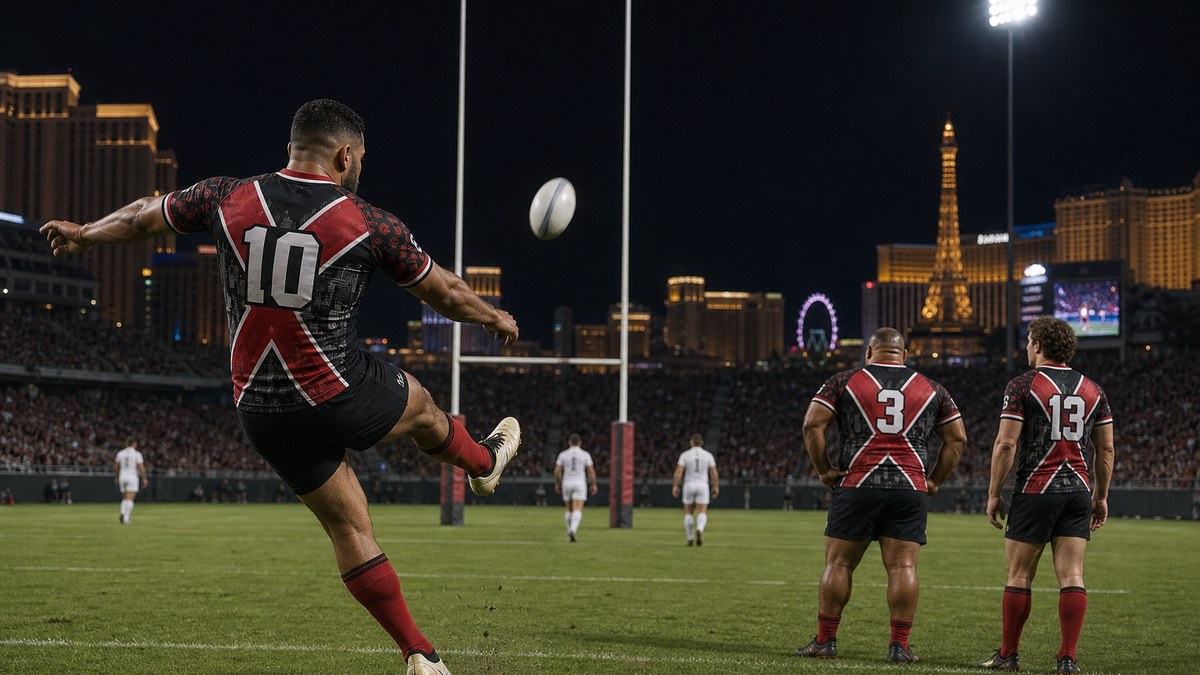
Conversions follow the same tempo. The kick "must be a drop kick" and has to be taken within 30 seconds of the try being awarded. Many sevens teams take conversions from close to the posts, so the try-scorer often tries to touch down near the middle. A clean drop kick under time pressure is a real skill, and sevens fly-halves practice it endlessly.
How do sevens tournaments and the HSBC SVNS series work?
Sevens is played in tournaments. Teams play several short matches over one to three days, usually starting in pools and moving into knockout rounds. That format is why sevens is so popular with clubs and fans: a whole competition fits into a weekend.
At the elite level, the HSBC SVNS series is World Rugby's international sevens circuit for men's and women's teams. On 28 July 2026, World Rugby confirmed the 2026-27 schedule, describing the series as playing "a critical role on the road to qualification for the Los Angeles 2028 Olympic Games."
| Dates | Event | Venue |
|---|---|---|
| 28-29 Nov 2026 (this weekend) | HSBC SVNS Dubai | The Sevens Stadium |
| 5-6 Dec 2026 | HSBC SVNS Cape Town | Cape Town Stadium |
| 30-31 Jan 2027 | HSBC SVNS Singapore | The Kallang |
| 6-7 Feb 2027 | HSBC SVNS Perth | HBF Park |
| 6-7 Mar 2027 | HSBC SVNS Vancouver | BC Place |
| 13-14 Mar 2027 | HSBC SVNS New York | Sports Illustrated Stadium |
| 9-11 Apr 2027 | World Championship | Kai Tak Sports Park, Hong Kong |
| 21-23 May 2027 | World Championship | Estadio José Zorrilla, Valladolid |
| 28-30 May 2027 | World Championship | Stade Atlantique, Bordeaux |
World Rugby listed eight men's teams (South Africa, New Zealand, Spain, Australia, Argentina, Fiji, France and the USA) and eight women's teams (Australia, New Zealand, Canada, the USA, France, Japan, Fiji and Spain) for the 2027 series, so American fans have both USA sides to follow. The New York stop in March is the closest series event to home.
The season starts this weekend. Dubai's The Sevens Stadium hosts the opening round of the 2027 series on 28-29 November, and World Rugby reported on 25 October 2026 that New Zealand return there to defend both titles they won at last year's event. The same venue also stages HSBC SVNS 3, a qualifier for emerging sevens nations, on 27-28 November, with promotion to HSBC SVNS 2 at stake. As World Rugby's sevens series general manager put it, "there is plenty to play for." Above the top tier, the HSBC SVNS 2 rounds follow in Nairobi, São Paulo and Montevideo in early 2027, so the sevens pathway now runs from emerging nations all the way to the Olympics.
The road ends at the Olympics. World Rugby confirmed on 14 January 2026 that at LA28, "12 men's and 12 women's teams will compete at Carson Stadium," and that rugby is set to take center stage on the first day of Olympic action, before the opening ceremony.
What does sevens have to do with Las Vegas?
A lot. For a decade, Las Vegas was one of the most famous weekends on the sevens calendar. The USA Sevens, the American leg of the world series, was played at Sam Boyd Stadium in Las Vegas from 2010 to 2019 before moving to Los Angeles, as NBC's history of sevens in the United States recounts. Thousands of fans and dozens of club and social sides came to town, and plenty of local players caught the sevens bug watching it.
The Blackjacks were part of that culture long before and after. The club was founded in 1976 after a newspaper ad recruited its first players, and it calls itself the city's oldest sports club. Its honors list counts three national titles, and in 2010 it won the USA Rugby Division I national championship, beating Belmont Shore 36–22. On the sevens side, the 2006 Tonik Sevens title sits in the Blackjacks trophy cabinet. You can read the whole story in rugby in Las Vegas: a history from 1976 to the APR Games.
Sevens exposes everything. There is nowhere to hide a poor tackler, a lazy support line or a forward who will not run. It is the best fitness and skills test in rugby, and every Blackjack, forward or back, comes out of a sevens weekend a better fifteens player.
Sevens vs tens vs fifteens: which format suits you?
Rugby union now comes in three popular formats. The APR Games 2027 use the middle one, tens, which keeps much of the space of sevens but adds more forwards and longer halves.
| Sevens | Tens (APR Games) | Fifteens | |
|---|---|---|---|
| Players per side | 7 | 10 | 15 |
| Match length | Two halves of up to 7 minutes | Two 20-minute halves at the APR Games | Two 40-minute halves |
| Scrum | 3 a side | Larger pack than sevens | 8 a side |
| Best suited to | Pace, fitness, one-on-one skills | Athletes who want space plus contact | Every body type and specialist roles |
| Typical event | One- to three-day tournament | Weekend tournament | Weekly league match |
Full rules for the APR Games will be confirmed with player registration. For how defenses adapt to the extra space in tens, see the Knights' guide to defending in tens rugby. And if you prefer a no-contact start, Downtown Rugby explains touch rugby, which builds the same handling and support skills that sevens demands, and compares the formats side by side in tag rugby vs touch vs sevens.
How to train for sevens safely
Sevens is still full-contact rugby. Tackles happen at higher speeds and in more open space than in fifteens, so technique and conditioning matter even more. A few principles most coaches agree on:
- Build the engine gradually. Repeated sprints with short rest are the core of sevens fitness. Increase volume over weeks, not days.
- Practice tackling in space. Footwork, staying square and a low, legal tackle height, drilled first on bags and shields before live contact.
- Drill the restart. Short kick-offs, chasing, and catching and protecting the ball in the air.
- Practice drop kicks under time. Set a 30-second clock in training, because that is all you get in a match.
- Recover between games. Tournament days mean several matches, so plan food, fluids, rest and shade, especially in Las Vegas heat.
Most important of all: learn contact under a qualified coach. In the United States, USA Rugby requires coaches of tackle rugby to hold World Rugby Level 1 certification, complete Rugby Ready and concussion courses, keep SafeSport training current and pass a background check. If you take a knock to the head, stop playing and get checked by a qualified person. This article is not medical advice.
If you are building a sevens or tens squad for a tournament weekend, keep it simple off the field too. Plenty of teams now use small, home-built apps to track attendance, sprint times and selection; our partner Vibe Coding covers how people build tools like that with AI.
From sevens speed to tens in Las Vegas
The APR Games 2027: Memorial Day weekend, May 29–31, Las Vegas. 10-a-side rugby, two 20-minute halves, evening kickoffs across three fields. Men's Elite ($10,000 prize pool), Women's Social ($5,000) and Youth divisions. Player entry $299 includes a jersey, kit bag, at least three pool games and opening-night access.
Join the APR Games waitlistHow to get into sevens with the Blackjacks
- Join The Breakdown. American Pro Rugby's free weekly newsletter has rugby news, one skill broken down each week and Blackjacks tryout information first. Subscribe here.
- Learn under a coach. APR's coaching clinic runs May 28–31, 2027, alongside the Games.
- Get on the waitlist. Player registration for the APR Games opens through americanprorugby.com.
- Follow the circuit. Keep up with HSBC SVNS results and the road to LA28 on APR's global rugby news.
Coming to Las Vegas for the Games? Luna Appleton covers where to stay, eat and celebrate in the city. Find team gear in the APR merch store, read The Blackjacks Way, and meet every franchise on the APR teams page, including the Vegas Kings, Vegas Knights, Vegas Lions and Downtown Rugby.
Frequently asked questions
How long is a rugby sevens match?
Fourteen minutes plus time lost, split into two halves of no more than seven minutes, with a half-time break of up to two minutes. A competition final may last up to 20 minutes, in two halves of up to 10 minutes.
How many players are on a sevens team?
Seven on the field: three forwards and four backs. A team may nominate and use up to five replacements under World Rugby's sevens variations.
Is the field smaller in sevens?
No. Sevens is played on a full-size rugby pitch, the same as fifteens, which is why there is so much space and why speed matters so much.
Why are conversions drop kicks in sevens?
The sevens laws require every conversion and penalty kick at goal to be a drop kick, and the conversion must be taken within 30 seconds of the try. It keeps the game moving in a format where every second counts.
Who kicks off after a try in sevens?
The team that scored. In fifteens the other team kicks off, but in sevens the scoring team restarts with a drop kick from the center of the halfway line within 30 seconds.
How long is a yellow card in sevens?
Two minutes in the sin bin, compared with ten minutes in fifteens. In a 14-minute match that is still a large share of the game.
What happens if a sevens match is tied?
When a winner is needed, extra time starts after a one-minute break with periods of up to five minutes, and the first team to score wins immediately.
Is rugby sevens in the Olympics?
Yes. It debuted at Rio 2016 and was played again at Tokyo and Paris. At LA28, 12 men's and 12 women's teams will compete at Carson Stadium.
Did Las Vegas host international sevens?
Yes. The USA Sevens, the American leg of the world series, was played at Sam Boyd Stadium in Las Vegas from 2010 to 2019 before moving to Los Angeles.
Are the APR Games sevens?
No. The APR Games 2027 are 10-a-side rugby with two 20-minute halves. Full rules will be confirmed with player registration.
Keep reading
Sources
- World Rugby Passport: Laws of the Game, sevens variations (Laws 3, 5, 8, 12 and 19; accessed 23 November 2026)
- World Rugby: HSBC SVNS 3 returns to Dubai for a bumper weekend of rugby sevens, 25 October 2026
- World Rugby: HSBC SVNS series and World Championship 2027 schedule confirmed, 28 July 2026
- World Rugby: Olympic rugby sevens set for LA28 as ticket registration opens, 14 January 2026
- World Rugby: New Zealand retain Olympic women's rugby sevens gold in Paris, July 2024
- Team USA: U.S. women make history with the first-ever medal in rugby 7s, 30 July 2024
- Rugby World: How are the laws of sevens different to XVs?, 1 July 2022
- NBC: Looking back at World Rugby sevens history in the United States (accessed 23 November 2026)
- Wikipedia: Rugby sevens, origins and Olympic history (accessed 23 November 2026)
- USA Rugby: Coaching education and compliance requirements (accessed 23 November 2026)
- American Pro Rugby: APR Games 2027
This article explains rugby sevens using the World Rugby, USA Rugby and other sources listed above, current as of November 2026. Laws, competition formats and schedules change, and unions and tournaments adopt variations at different times, so check with your referee, union or event organizer. Rugby is a contact sport: learn tackling and all contact skills under a qualified coach. This article is not medical advice.